
HISTORY IN COLOUR: Rangers Colouring Pages for All Ages
/The Queen’s York Rangers Regimental Council is sharing a collection of colouring pages for all ages. Designed to make history more accessible and engaging, these pages invite participants to interact with the Regiment’s story in a creative, hands-on way—turning learning into something memorable and personal.
For teachers, these pages offer a simple and meaningful way to bring local history into the classroom, spark curiosity, and help students connect with the people and moments that shaped our province.
The images highlight different eras and emblems of the Regiment—from John Graves Simcoe, who helped lay the foundations of Ontario, to the modern Rangers who continue to serve Canada today. By combining art with storytelling, the pages encourage learners of all ages to explore history in a way that feels relevant and engaging.
The first set of colouring pages includes:
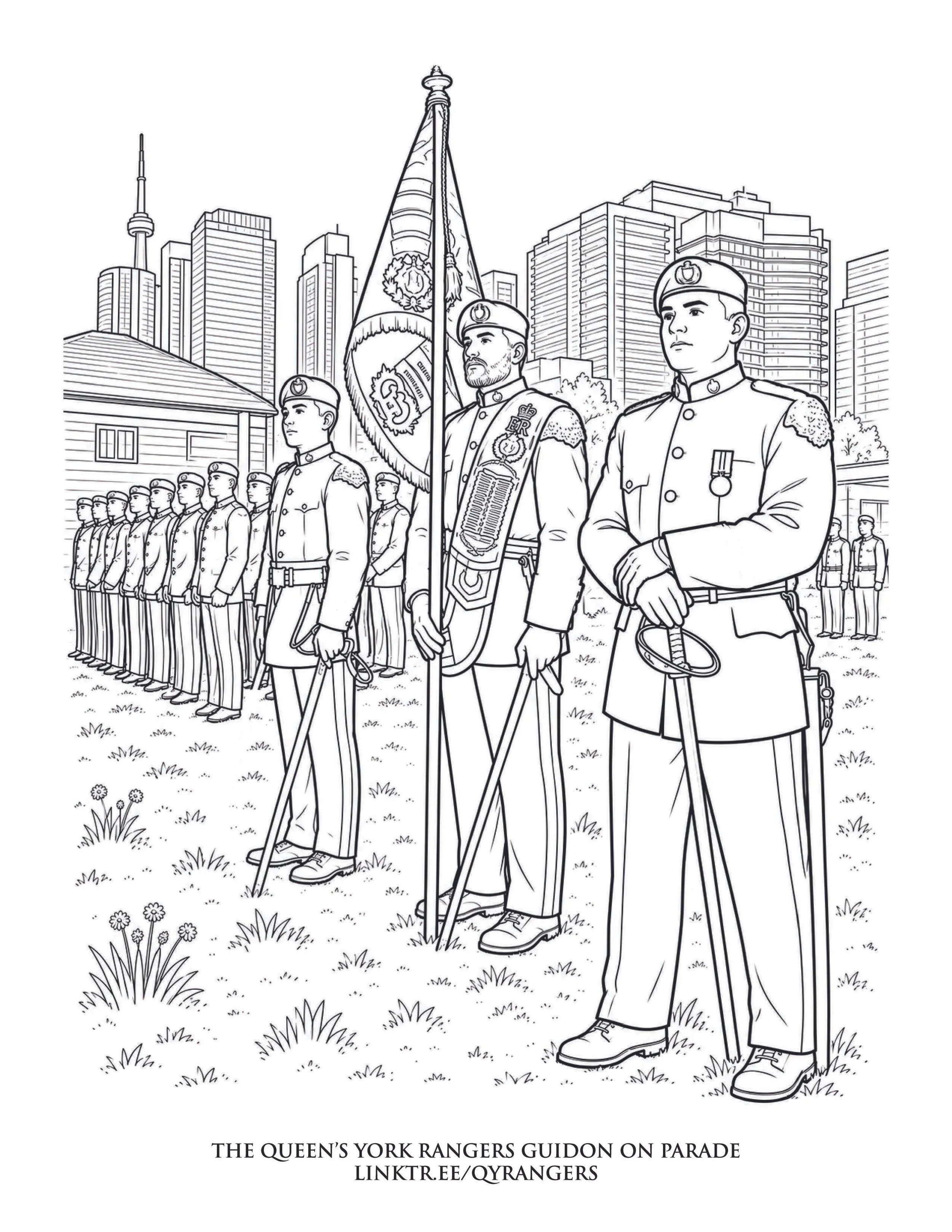
The Queen’s York Rangers Guidon on Parade
A guidon is a small swallow‑tailed flag carried by a military unit as a rallying point, identifier, and symbol of pride. It often displays the unit’s battle honours.
The guidon of The Queen’s York Rangers (1st American Regiment) bears honours from the War of 1812, the North‑West Resistance, the First World War, and Afghanistan. Its white rams show the regiment’s infantry origins, in contrast to cavalry units that use white horses. The crescent moon badge, derived from the goddess Diana the Huntress and adopted during the Revolutionary War, is an ancient regimental symbol. The current guidon, incorporating selected battle honours, was presented to the Regiment on May 14, 2022, by the Governor General of Canada.
The Crescent Moon on a Queen’s Ranger’s Hat (two colouring pages)
Since the 1700’s command of John Graves Simcoe the Regiment has proudly displayed the crescent moon as a symbol of The Queen's York Rangers.
The Crescent moon is an ancient symbol representing Artemis (to the Greeks) or Diana (to the Romans), one of the 12 main Olympians of the Ancient pantheon. In the past, the Rangers wore light infantry hats that prominently depicted the moon as a Regimental badge.
Artemis is the Greek Goddess associated with hunting, the wilderness and wild animals. The crescent moon symbol is seen on statues and artwork depicting Diana such as this statue housed in the Vatican Museum. Along with a Crescent moon as a crown or headband, the statue of Diana holds a bow and is accompanied by a dog representing hunting. This style of wearing a moon on a headdress is seen in early depictions of the Queen's Rangers. The moon points up towards the sky.
The use of the Crescent moon by the Rangers continues to reflect the tasks that the Rangers undertake. Like Artemis, long-range reconnaissance is one of the signature duties of the Rangers and it ties in closely with Artemis' hunting aspects. Under Robert Rogers during the 7 Years' War, the Rangers were tasked at multiple different times to forage through the wilderness at any time of year to scout for the enemy or their camps, like the Goddess of the wilderness.
Rogers is well-known for his 28 Rules of Ranging, which he created as a guideline while leading his Rangers during the 7 Years' War. Many of these rules pertain to surviving and serving in the wilderness, whether it be scouting for the enemy, how to create a safe camp or what to do when in the field in/around certain terrains, "such as avoiding passing lakes too close to the edge, as the enemy could trap you against the water’s edge". The moon may wax and wane, but the Rangers’ crescent has remained for nearly 250 years.
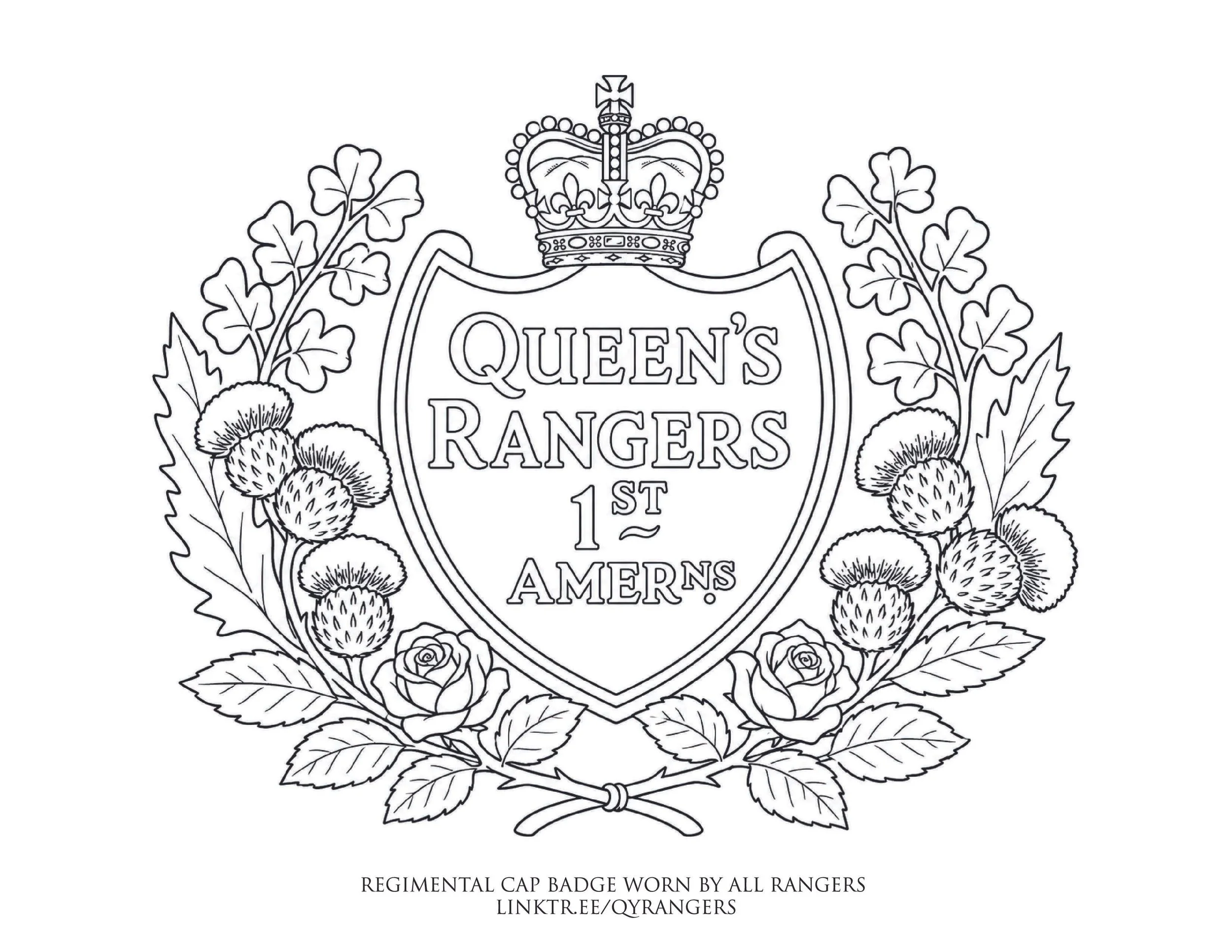
Regimental Cap Badge Worn by All Rangers
The badge prominently features the words Queen's Rangers 1st American, a title that was granted to the Regiment during their service in the American Revolution as the first regiment of the British Army comprised of soldiers from the Americas. The plants that surround the badge represent the original members of the Regiment: the green clover for Ireland, the purple thistle for Scotland and the red rose for England.
John Graves Simcoe and the Queen’s Rangers Building Yonge Street
After Simcoe was appointed Lieutenant Governor of Upper Canada, he came from England to Newark (Niagara-On-The-Lake), which was the capital at the time. In Newark he realised the threat of an American invasion because of the town's proximity to the border so he set out to create a new capital. His first idea was London but instead he chose the more defensible location of York (Toronto) so he moved to the area and brought with him many soldiers who served under him in the American Revolution to defend the region. As they arrived in the newly founded town, the Rangers were put to work building many of the early sites and roads, many of which are visible today including Fort York, Front Street and Yonge Street. Yonge Street runs North-South from Lake Ontario to Lake Simcoe
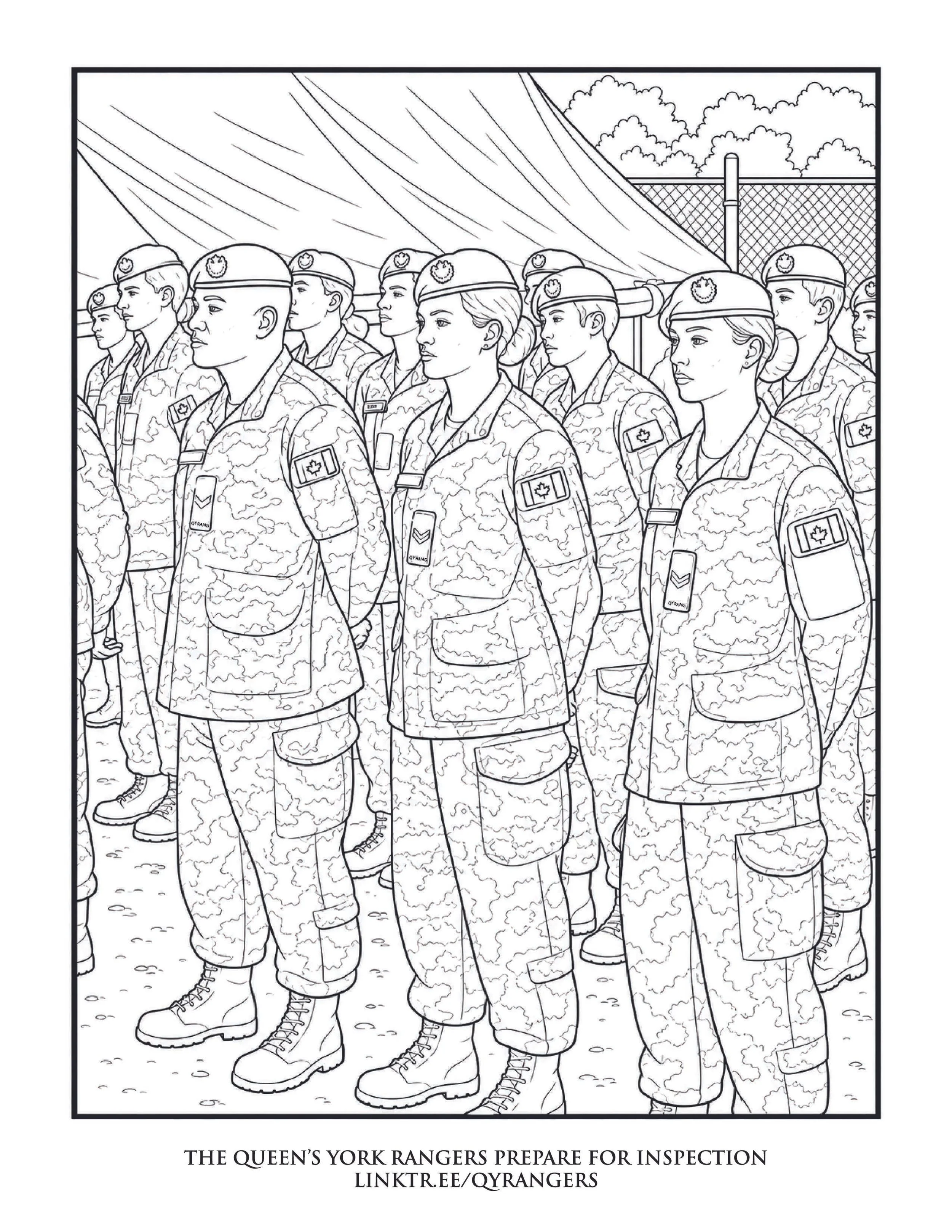
The Queen’s York Rangers Prepare for Inspection
The Rangers are located in Toronto’s Fort York Armoury and Aurora’s John Graves Simcoe Armoury. As a Reserve armoured reconnaissance regiment, they meet once a week on Wednesday evenings and one weekend a month
Follow the link to download and print the pages at home or for your classroom: https://drive.google.com/drive/folders/1K5uGlhZSBDVj0n-pc46ZETAmtG56tXMO
This is just the beginning. With over 250 years of history, there are many more stories to come—stay tuned!